
At What Point?

At what point?
In the movie Sliding Doors, the movie splits early on into two stories which run simultaneous with one another. The moment of the split happens with a little girl sliding a doll along the railing in a subway station (specifically The Tube in London—translating back into English for my UK audience). In one scenario, the mother pulls the child out of the way of a running Gwyneth Paltrow, so that she catches her train. In the other, Gwyneth Paltrow is forced to run around and misses her train. This one single and seemingly benign act has a profound impact upon the life of the character that Paltrow portrays.
I’ve often found myself contemplating these type of split scenarios, not least of which when I have had some sort of delay in leaving the house to drive somewhere only to find myself passing by an accident on the road that has just happened. I cannot help but feel grateful for that extra minute or two delay which might otherwise have had me in the middle of the accident.
On the flip side, I would posit that at some point prior to COVID, the world split into a truly mad version of itself. (Did someone step on a butterfly?!) Are we all now in the version of the story where the mother has moved the child? Or, the one where she misses the train? Should we have gratitude for the delay? Or, have we caught the train and ended up in a far more tragic storyline?
And, most importantly, can a particular singularity be pinpointed by which we may reset the story?
Could this be a true statement: Culture and society can be described as the sum total of the stories we tell each other?
If true, then is it not of prime concern to analyze and put great care into choosing the stories we tell and allow our children to be nurtured?
This would certainly seem to be the case with an ever increasing number of school boards to Supreme Court battles over the rights of parents to have a say in what stories their children are told.1
What’s more, as was described in Bulgakov’s Master & Margarita, the devil is in the detail. Quite literally. The subtle switch of words, the seamless swapping of adjectives, the connived dropping of a noun, all played into the “Professor’s” ability to alter perception. One may see examples of this everywhere. It has become quite an effective tool of manipulation for those who choose pathos and ethos over logos.
Would better awareness of the power of language make a profound enough impact?
In May of 2020, I remember hearing something in a podcast that has proven itself true over and over again: COVID did not cause anything to happen which was not already in the making; it simply accelerated what was already there. I think that is rather profound. So, what is it precisely that caused the madness?
I would argue that it involved the usurpation of language and literature, specifically via tyrannical creep over language most vividly manifested with the switch from “I think” (logos) to “I feel” (pathos) which happened somewhere between the time I was in school and somewhere around the time my kids would have been in school, though I cannot pinpoint any one event from which this change began.
At what point did people lose their courage to think and ability to defend their point of view in the arena of free speech and reason? At what point did lies become truth and manipulation celebrated? At what point did victimhood become the hero’s journey and real victims cast as villains? At what point did the mere accusation of thought crimes become such an accepted and fashionable form of power and virtue get conflated with vanity and “pride”? At what point did these ideas take root and, more importantly, what is there to be done about it? For surely, these are all contributing factors to the collapse of our civilization. We have literally lost the plot.
Foundational Concepts
Is there a connection with the current demonization of Christianity and the corollary dismissal of individuality?
As a kid, I read books. There was no Google. No information easily at your fingertips. I simply read the book.
As a parent, I often read the books to my kids that I (or my husband) had read as a kid. I took recommendations from other parents and especially from a couple of really amazing children’s librarians. There was very little googling. Again, I simply read the book.
Now, in yet another stage of life, as I read and/or re-read books, I have been continually struck by the pattern of literature which I find refreshing or edifying to read. I have thoroughly enjoyed diving into the works of Laura Ingalls Wilder, Elizabeth George Speare, Katherine Patterson, Beverly Cleary, G.K. Chesterton, C.S. Lewis, J.R.R. Tolkien, Mikhail Bulgakov, Ralph Moody, Lois Lowry, Astrid Lindgren, Gertrude Chandler Warner, Anna Sewell, J.M. Barrie, Mark Twain, Robert Frost, James Thurber, Carlo Collodi and T. S. Eliot, to name but a few from the past year.
Some of the most toxic books and/or introductions to otherwise good books that I have read were written by Louis Sachar, Richard Thaler & Cass Sunstein, Joseph Bruchac’s copyrighted introduction to Sign of the Beaver by Elizabeth George Speare (which was so off-putting that I almost did not read the book), the copyrighted introduction by Naomi Wolf to The Indoctrinated Brain by Dr. Michael Nehls (whom I had previously gained a respect for as an outspoken critic of the mRNA technology, but have subsequently found quite toxic), and most heart-breakingly excerpts which describe Theodore Geisel, the person. (To note, I will never not love and appreciate Dr. Seuss, but I now have a different perspective on the man himself.)
As I do now have easy access to a search engine, I have been surprised to find that there is apparently a significant link between internalized doctrine in which one has been raised and what I have found to be toxic vs healthy thought patterns. Take that as you will. I certainly do not condemn any individual to the group to which they may happen to belong. The pattern, though, is undeniable. Needless to say, this has had a profound impact upon my own internal journey.
Cursive
Is there a correlation or even causation between taking cursive out of the curriculum (as the physical act of writing cursive makes connections in the brain) and the inability to formulate and defend one’s thought?
Socrates, of course, argued the entire idea of writing is detrimental to the thought process and memory, an argument also made in the linked article in the previous paragraph. There is much to be said for the argument.
With that said, for the past several Halloweens, when it is customary in my area to make the child tell a joke to you before you give them a piece of candy for Trick-or-Treating, there are now a non-insignificant number of teenagers who cannot tell a joke from start to end without looking at their phone several times in the middle. (And, we’re talking about one-liners and Knock-Knock Jokes.) So, clearly there are things worse than pencil and paper.
This is such a seemingly benign event…like the little girl playing with her doll.
Yet, if one cannot write cursive, one loses connections in the brain.
If one cannot read cursive, one is cut off from many vital primary source, much the same way that Mao cut off and was able to rewrite history by “simplifying” written Chinese during the Cultural Revolution.
When that happens, one may merely substitute a word here or there, fiddle around with an adjective or two, and end up with an ideology hell-bent on destroying liberty, thought, truth, and beauty.
With no small sense of the irony, after a couple of decades of calling it an archaic and therefore unnecessary waste of educational time, it is not the research into the effects found in the lack of memory or brain development, but rather AI/ChatGPT which has pushed educators into creating human checks. In other words, after years of decrying the lack of “progressiveness” of the art of handwriting, arguing the need for “progress” into 21st century skills and tools, educators are scrambling to implement requirements of paper and pencil in order to prove the student is human and the one doing the “thinking”.
Literary Departure
Looking back through history at the stories which have been told, and more importantly, which stories have survived the test of time, I am struck by the departure in literature from tales of heroes, journeys overcoming hardship, and stories which spark the imagination, to that of cursing, low-brow, low achieving and low life. We have shifted from books which expand the vocabulary as much as the perspective to books which wallow in victimhood and celebrate darkness, depression, and angry or unfeeling soullessness. We have “progressed” from The Odyssey to Flamer, from The Hobbit to Me and Earl and the Dying Girl, from The Little Engine That Could to Born Ready: The True Story of a Boy Named Penelope.
What happened? Was there a single departure point? Was there a particular moment when a little girl was playing with a doll on the stairs which so altered the course of events?
I think of some books I have re/read recently:
George MacDonald’s The Princess and the Goblin.

It is on the one hand so innocent, a tale of courage, a story that is both imaginative and compelling, in which both a boy and a girls are joint, yet distinctly different types of heroes. And, yet, if one wanted, one may easily twist several of the passages into darker meaning. George MacDonald is purported to have influenced the likes of G.K. Chesterton, C.S. Lewis, and J.R.R. Tolkien, but did he also influence those with darker imaginations which slowly manifested over time into books like?
The Little Princess and A Secret Garden by Frances Hodgson Burnett

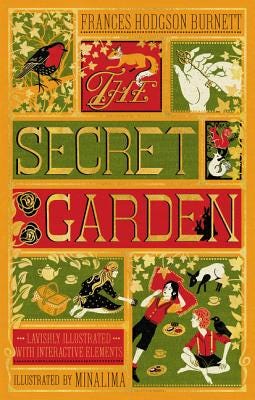
Both of these books incorporate positive thinking and transformation of attitude towards overcoming hardship and achieving a positive outcome. Yet, there is much reliance of “magic” and what might one may rightly argue, if one were so inclined, as being less Christian Science than Luciferian. On the one hand, I do love a good character transformation, particularly while embracing and overcoming suffering of one sort or another. I certainly appreciate taking ownership of one’s attitude and responsibility for the consequences of one’s choices. On the other, it would be very easy for this to be a light mask for far darker themes, such as embracing the supernatural and self-empowerment to the point deifying oneself. Are these books truly the benign and magnificent examples of classic children’s literature? Or, were they gateways to the occult?
Sign of the Beaver by Elizabeth George Speare

This is a lovely coming of age story of a boy left on his own in the wilds of Maine. From the introduction, though, we are presented an ultra-toxic mindset, lectured on problematic points in the text in terms of non-adherence to the woke religion, and made fully aware of the one true villain: a white man. The framing of the story itself is copyrighted (my first introduction to a copyrighted introduction to a book). As one who has always read a book from cover to cover, this introduction and hijacking and framing of the story was such a put-off that I nearly walked away from the book altogether. Was that the point? That would have been a shame as it is otherwise a much needed story in a day and age where teenagers and young adults are infantilized. This is the story of the potential and previous recognition of the capabilities of “children.” Heaven forbid we allow kids an unfettered view of what struggles they themselves are capable of overcoming.
At What Point?
If stories are indeed key to the plot of the human race, can we pinpoint a single (or multiple) points of departure whereby we lost the plot? If so, what, if anything, can we do about it?